

Pricing a product sounds simple until you realize you've been confusing markup with margin — and quoting deals that lose money. If you're a B2B sales rep, pricing manager, or importer, understanding how to calculate selling price using markup percentage is one of the most practical skills you can master. If you haven't yet read our overview of the difference between margin and markup, start there first — the distinction matters before you run any formula.
What Is Markup Percentage?
Markup percentage is the amount added to the cost price of a product to arrive at the selling price, expressed as a percentage of cost. It answers the question: how much am I adding on top of what I paid?
Markup % = ((Selling Price − Cost Price) ÷ Cost Price) × 100
For example, if your cost is $80 and you sell for $100, your markup is 25%. That's different from your margin, which would be 20% — a common confusion that causes real-world pricing errors.
The Selling Price Formula Using Markup
Selling Price = Cost Price × (1 + Markup % ÷ 100)
Step-by-Step Example
- Identify your cost price — e.g., $120 per unit (includes purchase, freight, duties)
- Decide your markup target — e.g., 40%
- Apply the formula: $120 × (1 + 40 ÷ 100) = $120 × 1.40 = $168
- Your selling price is $168 per unit
Markup vs. Margin: The Critical Difference
Both describe profit but from different reference points. Markup uses cost as its base; margin uses selling price. If your cost is $80 and sell price is $100, markup is 25% while margin is 20%. If your company reports 20% gross margin targets and you price using 20% markup, you'll fall short every time — the actual margin on a 20% markup is only 16.7%.
Common Markup Percentages by Industry
- Wholesale distribution (standard): 15% – 30%
- Wholesale distribution (premium): 30% – 50%
- Manufacturing (volume): 20% – 40%
- Manufacturing (specialty): 40% – 80%
- Retail / branded goods: 50% – 100%+
How to Factor in Landed Cost Before Applying Markup
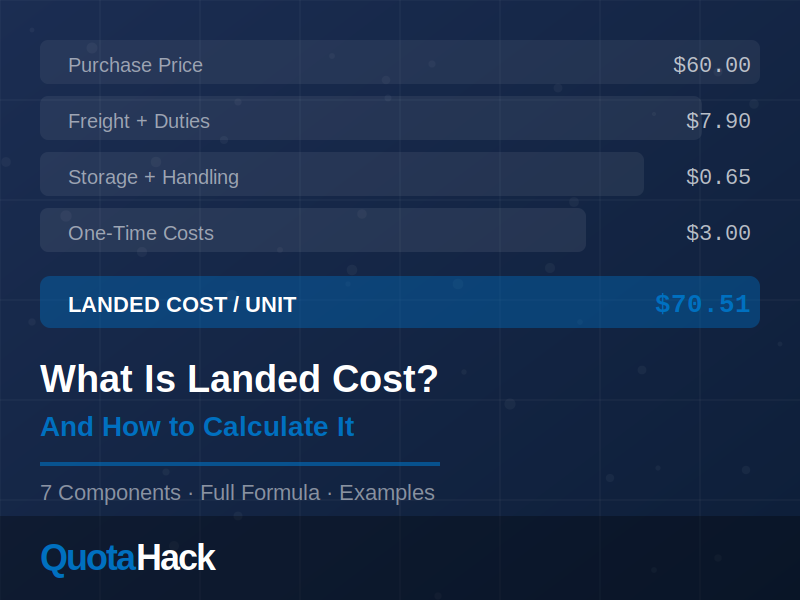
A common mistake is calculating markup on the ex-works purchase price while ignoring freight, duties, storage, and handling. Always mark up on your true landed cost. This is a critical step — see our complete guide to calculating landed cost to make sure you're marking up on the right number.
True Cost = Purchase Price + Inbound Freight + Import Duties + Storage + Handling
If you purchase at $80 EXW, pay $12 freight, $8 duties, and $5 handling, your landed cost is $105 — not $80. Applying a 40% markup on $80 gives you $112. On $105, it gives you $147. That $35 gap is your margin erosion. The Incoterm you buy under determines which of those costs fall to you — for a full breakdown, see Incoterms 2020 explained for importers.
From Markup to Per-Unit Selling Price
Once you've applied your markup to the correct landed cost, the result is your per-unit selling price. For a step-by-step walkthrough of the full per-unit pricing workflow — including Incoterm obligations and common errors — read our guide on how to calculate selling price per unit.
Calculate Selling Price Automatically With the QuotaHack B2B Pricing Calculator
The QuotaHack B2B Pricing Calculator handles all 8 ICC 2020 Incoterms, automatically layers in inbound freight, duties, storage, commissions, and outbound logistics — then applies your target margin (or markup) to surface the final sell price instantly.
Key Takeaways
- Markup is always calculated on cost; margin is calculated on selling price
- Formula: Selling Price = Cost × (1 + Markup ÷ 100)
- Always apply markup to your full landed cost, not just purchase price
- Industry markup benchmarks range from 15% (volume wholesale) to 100%+ (branded retail)
- Tools like QuotaHack automate this across Incoterms, currencies, and complex cost structures
Related Reading


Start where it feels easiest
Whether you want a guide, a tool, or direct help, there’s a simple way to begin.
Reassurance: Built for everyday operators who want practical AI help now.