
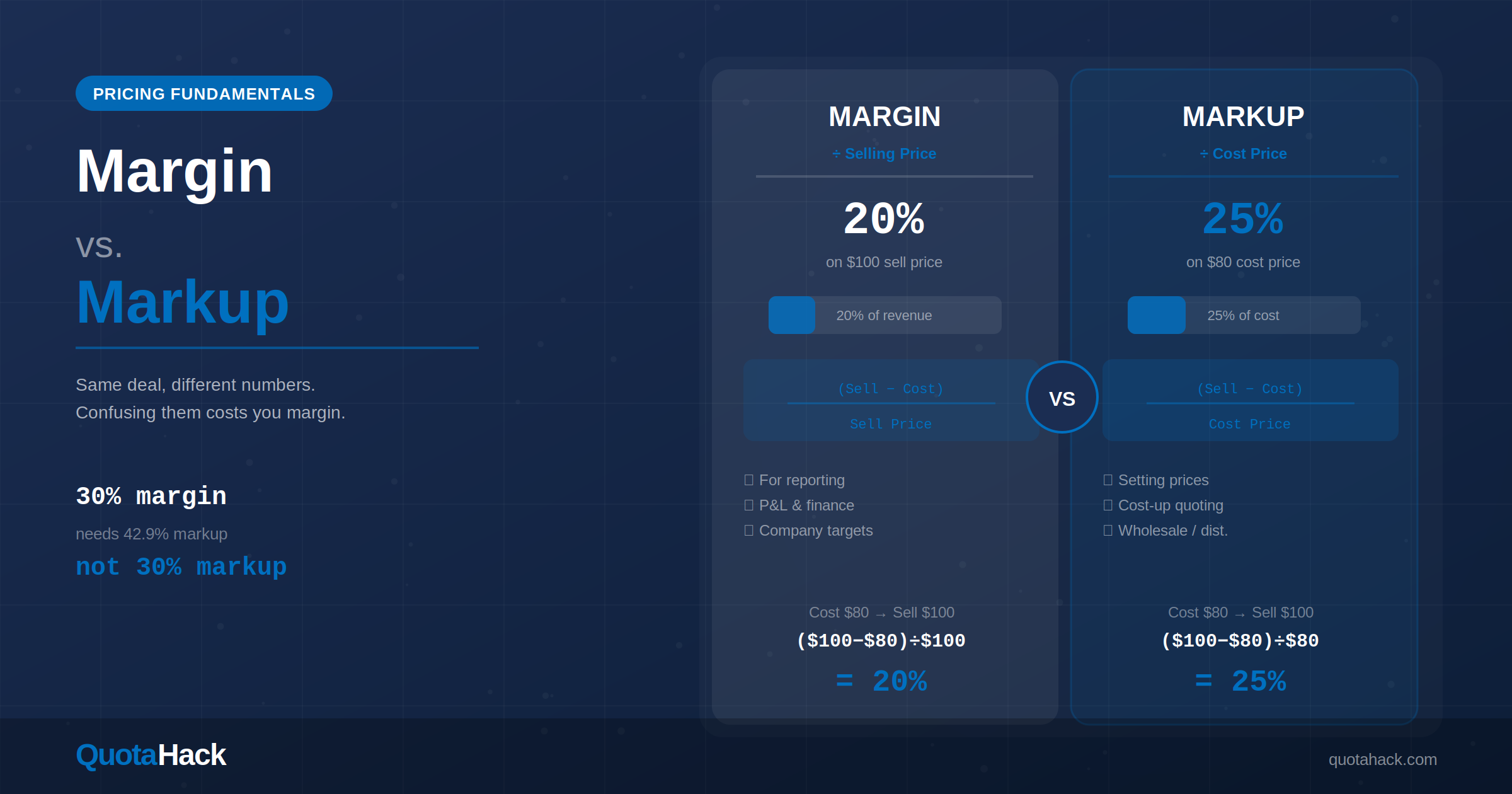
Margin and markup are the two most commonly confused concepts in B2B pricing — and the confusion is expensive. Sales reps who price on markup when their company targets margin end up delivering less profit than expected. Importers who quote 'a 25% margin' when they mean 25% markup are overpromising to finance.
This article resolves the confusion permanently with clear formulas, a worked example, and a practical guide to when to use each.
Definitions
Gross Margin (%)
Gross margin measures profit as a percentage of the selling price. It answers: 'Of every dollar I sell, how many cents are profit?'
Gross Margin % = ((Selling Price − Cost) ÷ Selling Price) × 100
Markup (%)
Markup measures how much you added to the cost, as a percentage of the cost. It answers: 'How much did I add on top of what I paid?'
Markup % = ((Selling Price − Cost) ÷ Cost) × 100
The Critical Difference in Numbers
Same deal, same profit — two very different percentages. With a cost of $80 and selling price of $100, the gross profit is $20 in both cases. But margin is 20% (of $100) while markup is 25% (of $80). The reference point is everything.
If you tell your customer you're working on '20% margin' when you actually mean 20% markup, you'll deliver a 16.7% margin — and your sales director will want to know why.
Conversion Formulas
Markup % = Margin % ÷ (1 − Margin %)
Margin % = Markup % ÷ (1 + Markup %)
- 20% margin → Markup = 0.20 ÷ 0.80 = 25%
- 30% margin → Markup = 0.30 ÷ 0.70 = 42.9%
- 25% markup → Margin = 0.25 ÷ 1.25 = 20%
- 50% markup → Margin = 0.50 ÷ 1.50 = 33.3%
When to Use Margin vs. Markup
Use Margin When:
- Reporting profitability to finance, management, or investors
- Your company has a gross margin target (e.g., 'maintain 30% GM')
- Comparing product lines or categories — margin normalizes across price points
- Working with P&L and income statement context
Use Markup When:
- Setting prices from a cost-up approach (you know the cost, need the price)
- Working in wholesale or distribution where cost-plus pricing is standard
- Your pricing system, ERP, or quoting tool calculates prices this way
The Most Common B2B Pricing Error
A sales rep is told: 'We need 30% margin on all deals.' They price using a 30% markup. The finance team sees 23.1% GM on every deal. The rep thinks they're compliant. The business is leaking 7 margin points on every order.
To achieve 30% margin, you need 42.9% markup. That's the number to use in your calculation. If you're not sure how to get from markup to a final sell price, see our guide on how to calculate selling price using markup percentage.
Margin, Markup, and Landed Cost
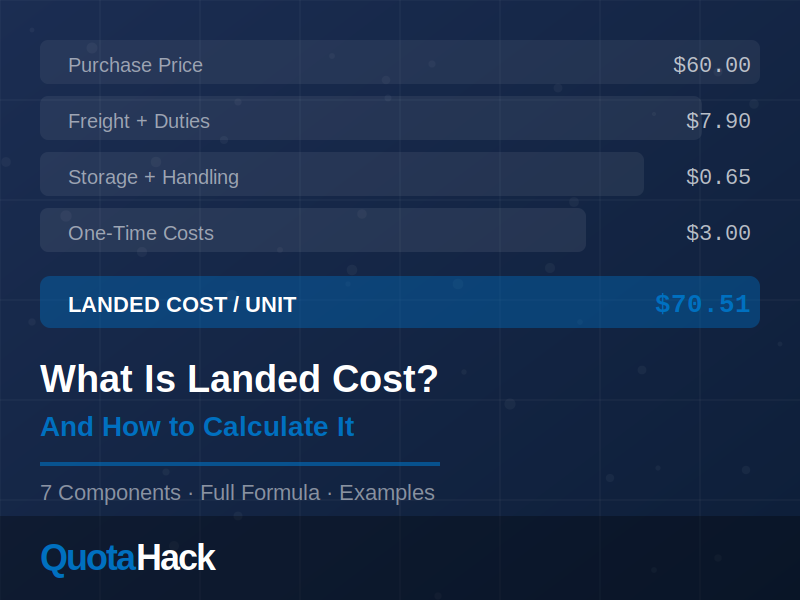
One layer most B2B reps miss: both margin and markup need to be applied to your true cost — not just the purchase price. Freight, duties, storage, and handling all increase your cost base. Applying a 30% margin to your EXW purchase price while ignoring $10/unit in freight is a silent margin killer. Read our full breakdown of what landed cost is and how to calculate it before you set your pricing floor.
How QuotaHack Handles This
The QuotaHack B2B Pricing Calculator uses margin-based pricing by default — you set your target margin %, and the tool back-calculates the sell price. This aligns with how most B2B finance teams measure profitability and eliminates the margin-vs-markup confusion entirely. It also handles all 8 Incoterms, so your cost base always reflects the full picture.
→ Start your free trial of the B2B Pricing Calculator — margin vs markup logic built in.
Summary
- Margin = profit ÷ selling price; Markup = profit ÷ cost price
- The same deal has a higher markup % than margin % — always
- To hit a 30% margin target, you need 42.9% markup — not 30%
- Use margin for reporting; use markup for cost-up price setting
- Confusing the two is the #1 silent margin killer in B2B sales teams
Related Reading


Start where it feels easiest
Whether you want a guide, a tool, or direct help, there’s a simple way to begin.
Reassurance: Built for everyday operators who want practical AI help now.