

Incoterms (International Commercial Terms) are the global standard for defining who pays what — and who bears the risk — in international trade. Published by the International Chamber of Commerce (ICC), the 2020 edition governs hundreds of billions of dollars in trade contracts. For importers, getting Incoterms wrong can mean unexpected freight bills, customs disputes, or uninsured cargo losses. And because the Incoterm determines which costs land with you, it directly affects your landed cost calculation — and therefore your sell price.
What Incoterms 2020 Actually Govern
Incoterms define three things between buyer and seller: (1) who arranges each leg of transport; (2) who pays each cost; (3) where risk transfers. They do NOT govern payment terms, title transfer, or product liability.
The 8 Incoterms 2020 at a Glance
- EXW — At seller's premises. Max cost/risk for importer — rarely practical.
- FCA — When handed to first carrier at named place. Most flexible — works for all transport modes.
- FOB — When loaded on vessel at origin port. Sea/inland waterway only.
- CPT — When handed to first carrier; pays freight to destination. Risk transfers at origin, cost coverage goes further.
- CIP — Same as CPT + provides minimum insurance. Seller provides insurance — check coverage level.
- DAP — At named destination, unloaded is buyer's. Common for door-to-door — importer pays duties.
- DPU — After unloading at destination. New in 2020; replaces DAT — seller unloads too.
- DDP — Full delivery including duties paid. Maximum seller obligation — importer pays nothing.
EXW — Ex Works
Under EXW, the seller's only obligation is to make the goods available at their premises. The importer arranges everything: export clearance, loading, international freight, insurance, import clearance, and final delivery. EXW gives importers maximum control but maximum responsibility. It's rarely practical because the importer needs to handle export formalities in the seller's country — often without legal standing to do so.
FCA — Free Carrier
FCA is often the most practical alternative to EXW. The seller delivers goods to the importer's nominated carrier at a named place. A key 2020 update: under FCA, parties can now agree that the buyer instructs their carrier to issue an on-board bill of lading to the seller — resolving a long-standing problem with letters of credit.
FOB — Free On Board
FOB is the most commonly used term for ocean freight from Asia. Risk transfers when goods are loaded on board the named vessel. The seller handles export customs and loading; the importer takes over once goods are on the ship. Note: FOB is only valid for sea or inland waterway transport. For containerized goods, FCA is technically more appropriate — but FOB remains market practice for many trade lanes.
CPT — Carriage Paid To
CPT splits cost and risk. The seller pays freight to the named destination but risk transfers to the buyer when the goods are handed to the first carrier at origin. This creates a gap: the buyer bears risk during the main freight leg even though the seller arranged it.
CIP — Carriage and Insurance Paid To
CIP is CPT plus insurance. A key 2020 change: CIP now requires all-risk insurance coverage (Institute Cargo Clauses A — the highest level), not just minimum coverage. This is a significant upgrade from the 2010 edition and from the FOB/CFR standard.
DAP — Delivered at Place
Under DAP, the seller is responsible for delivering goods to the named destination, ready for unloading, but does not clear goods for import and does not pay duties. DAP is widely used for road freight within Europe and for door-to-door courier shipments.
DPU — Delivered at Place Unloaded
DPU is new to Incoterms 2020 (replacing DAT). The seller delivers and unloads goods at the named destination — it is the only Incoterm where the seller bears unloading risk. The importer still handles import duties and customs clearance.
DDP — Delivered Duty Paid
DDP is the maximum obligation for the seller. The seller delivers goods cleared for import, duties paid, to the named destination. For importers, DDP is operationally simple — you receive goods with all costs included. But it can be expensive: sellers factor in duty risk and admin overhead, and you lose visibility into the actual landed cost structure.
Choosing the Right Incoterm as an Importer
- FOB or FCA: Use when you have your own freight forwarder and want to control the main freight leg
- DAP or DDP: Use when you want simplicity and are willing to pay a premium for the seller to manage logistics
- CIP: Use when you need proof of insurance (e.g., bank or letter of credit requirements)
- EXW: Avoid unless you have freight infrastructure in the origin country
Incoterms and Your Selling Price
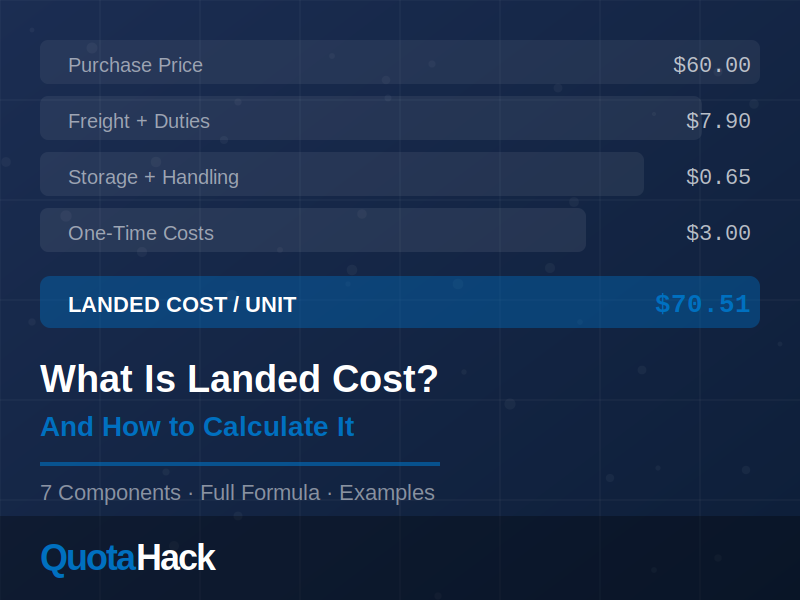
The Incoterm you buy under directly affects your landed cost — and therefore your sell price. If you buy FOB and quote your customer DAP, you absorb the main freight leg and customs clearance. Once you know your Incoterm, the next step is calculating your full landed cost — including freight, duties, insurance, and storage. See our guide on how to calculate landed cost for the complete formula.
From there, applying your target margin or markup gives you the correct selling price per unit. The QuotaHack B2B Pricing Calculator models all 8 Incoterms with the correct cost fields, so you always price from your true landed cost.
→ Start your free trial — calculate landed cost and sell price under any Incoterm.
Related Reading


Start where it feels easiest
Whether you want a guide, a tool, or direct help, there’s a simple way to begin.
Reassurance: Built for everyday operators who want practical AI help now.