Why Spreadsheets Are a Liability for International Trade Pricing (And What to Use Instead)

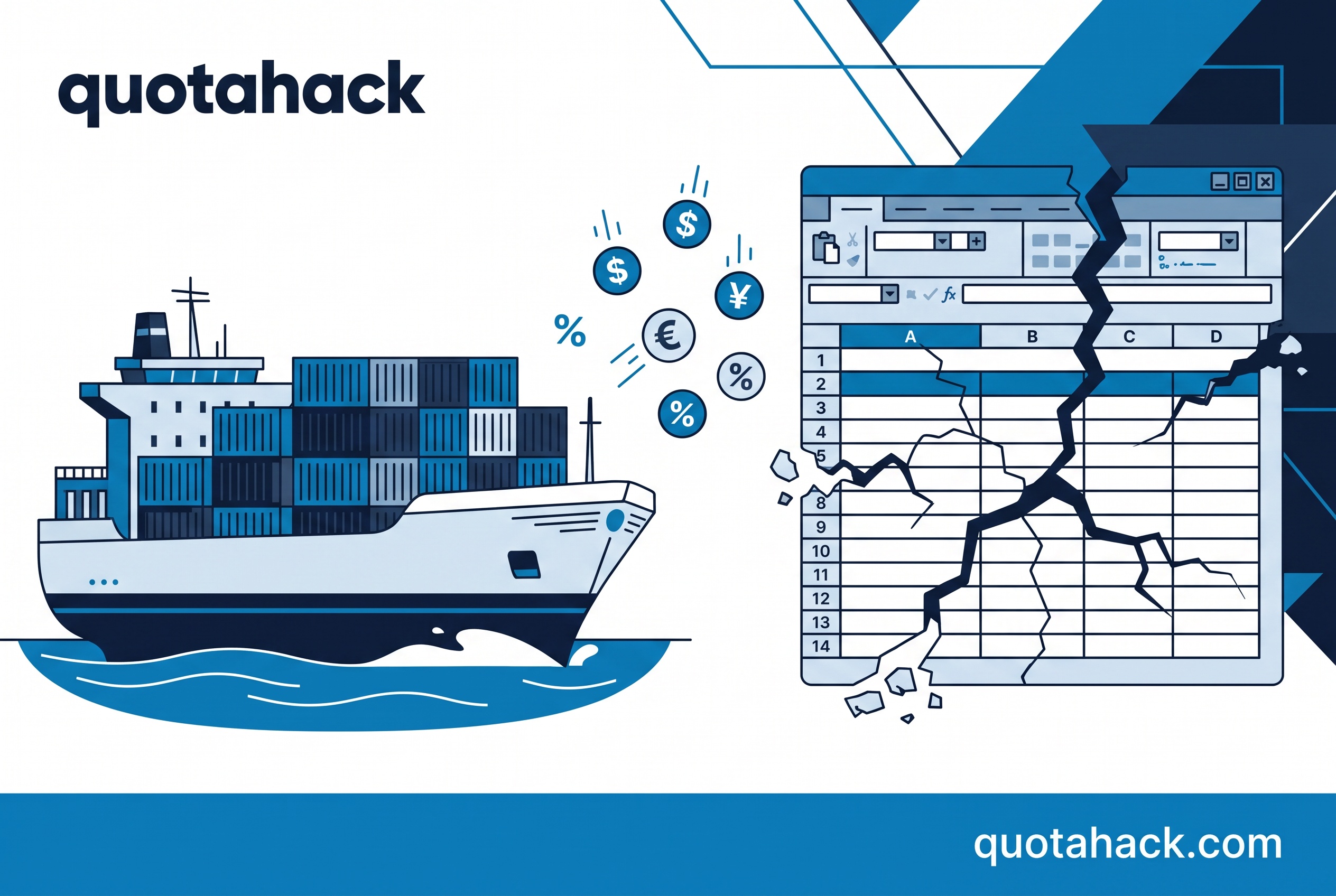
Why Spreadsheets Are a Liability for International Trade Pricing
Quick answer: spreadsheets can't track tariff changes, currency swings, and duty rules fast enough for accurate international trade pricing. That gap creates margin loss, mis-quoted deals, and compliance exposure — and it gets worse the more markets a company sells into.
The variables have outgrown the tool
Pricing a shipment for international trade used to mean adding freight and a markup. It no longer works that way. The average U.S. effective tariff rate jumped from 2.4% in 2024 to 7.7% in 2025 — the highest level since 1947 — and is projected to keep shifting through 2026 depending on which Section 122 measures stay in place. Currency has moved just as much: the U.S. dollar sat 7.6% weaker in February 2026 than its December 2024 average, while the Canadian dollar strengthened 0.7% over the same window.
Every one of those numbers changes a landed cost calculation. A spreadsheet built last quarter is already pricing against tariff and currency assumptions that no longer exist, and nobody gets an alert when that happens.
What a spreadsheet actually gets wrong
A spreadsheet doesn't fail all at once. It fails in four specific, well-documented ways:
Time lag. Vendor costs, duty rates, or exchange rates change on one day; the spreadsheet reflects it weeks or months later. Every quote sent in between hands margin back to the customer for free.
Manual entry errors. Case studies on quoting error rates show manual pricing workflows running close to an 8% error rate, dropping below 0.5% once the process connects directly to source data instead of a static file.
Undocumented logic. Pricing rules live in tab-referenced formulas one analyst understands. When that person leaves, the logic leaves with them.
No audit trail. When a customs auditor or a finance lead asks how a landed cost was calculated six months ago, "check cell F47" is not an answer that holds up.
Distributors running pricing this way have been shown to lose $250,000 to $1 million or more per year to delayed price updates alone, on top of 15–30 hours of weekly analyst time spent maintaining the sheet. Separately, disconnected quote-to-cash processes are estimated to leak 1–5% of EBITDA in revenue that's quoted incorrectly or never collected.
Why this hits international trade harder than domestic pricing
Domestic pricing has one currency and one tax jurisdiction to track. International trade pricing has to hold all of the following at once, updated in real time: duty rates and HS classification, currency conversion at the moment of quoting, freight and logistics cost variability by lane and carrier, and country-specific compliance requirements. A spreadsheet treats each of these as a static input, when in reality they move simultaneously — and the interactions between them are exactly what static formulas are worst at catching.
What accurate pricing requires instead
The fix isn't a better spreadsheet template. It's removing the manual re-entry step between "the world changed" and "the price reflects it." That means pricing logic connected to live duty, tariff, and currency data; a single source of truth for pricing rules; a full audit trail for every quoted price; and the ability to reprice instantly when a tariff schedule or exchange rate moves.
FAQ
Why are spreadsheets risky for international trade pricing?
Because tariffs, duties, and currency rates change faster than a manually maintained file can be updated, spreadsheets routinely price shipments against outdated assumptions — creating margin loss and compliance risk that often isn't visible until an audit or a bad quarter.
How much does manual pricing actually cost a business?
Documented cases show mid-market distributors losing $250,000 to $1 million or more annually to delayed price updates alone, separate from the 1–5% of EBITDA that can leak from disconnected quote-to-cash processes.
What's the alternative to spreadsheet-based pricing for global trade?
A pricing system connected to live tariff, duty, and currency data, with centralized rules and a full audit trail — so every quote reflects current conditions and every price is traceable.
Is this only a problem for large enterprises?
No. Smaller exporters and importers are often more exposed, because they're less likely to have a dedicated analyst monitoring tariff and currency changes daily, and a single mis-priced shipment has a proportionally bigger impact on margin.
Quotahack helps businesses calculate accurate, defensible international trade pricing without relying on static spreadsheets. Try the free B2B pricing calculator — landed cost and sell price across all 8 Incoterms.


Start where it feels easiest
Whether you want a guide, a tool, or direct help, there’s a simple way to begin.
Reassurance: Built for everyday operators who want practical AI help now.