Tariff Whiplash: Why Static Spreadsheets Can't Price International Trade Deals in 2026

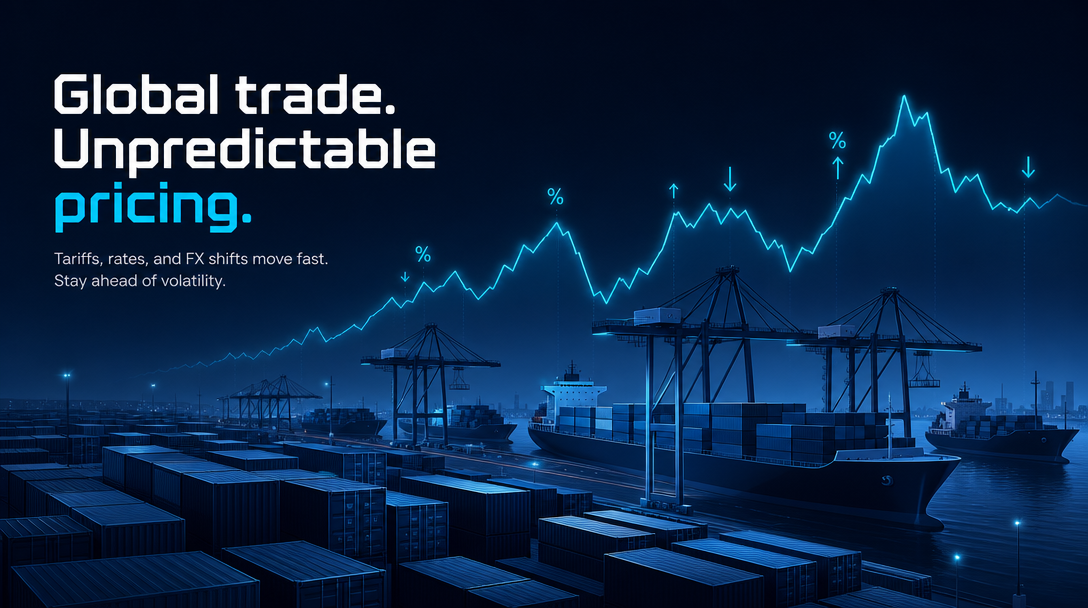
What changed in 2026
Trade pricing has always had variables. What's different this year is how fast they move:
- Tariff policy reversed mid-year. On February 20, 2026, the U.S. Supreme Court ruled 6–3 that the International Emergency Economic Powers Act (IEEPA) did not authorize the tariffs the administration had imposed on goods from China, Mexico, Canada, and the EU. Within hours, the administration pivoted to Section 122 of the Trade Act of 1974 and imposed a new 15% global surcharge effective February 24. Any landed-cost formula built around the old tariff structure was wrong within a day.
- Freight rates are no longer predictable by season. A transpacific rate that held steady for months can now swing 15–20% within a single quarter, driven by frontloading surges, capacity pullbacks, and carriers adjusting general rate increases around tariff-sensitive cargo. Fuel surcharges alone can account for 15–28% of total shipping cost depending on route and carrier.
- Currency moves land directly on margin. GBP/USD alone ranged from 1.3165 to 1.3823 across 2026 — a 5% swing. FX risk begins the moment you quote a price in a foreign currency, and everything that happens to the rate between quote day and payment day lands on your margin, not the customer's.
Any one of these would be hard to track in a spreadsheet. All three moving simultaneously is what "tariff whiplash" actually means for a pricing desk in 2026.
Why spreadsheets can't keep up
It isn't that spreadsheets are the wrong tool in principle — it's that they're static, and trade pricing in 2026 isn't. A few numbers make the gap concrete:
- 94% of spreadsheets used in business decision-making contain errors, according to recent research on operational spreadsheet quality.
- Operations teams lose 3.6 hours a week — about 22 full workdays a year per employee — fixing spreadsheet errors: broken formulas, copy-paste mistakes, and conflicting versions, per a 2026 survey of over 1,000 U.S. operations professionals.
- 57% of organizations reported a critical spreadsheet error in the past 12 months, and manual data entry mistakes account for the largest share of them.
None of that is about carelessness. It's what happens when a tool built for static numbers gets used to track numbers that move weekly — sometimes daily. A landed-cost tab with a hardcoded duty rate doesn't know the rate changed. A margin formula with a fixed exchange rate doesn't know the currency moved 2% since the quote went out. The spreadsheet isn't lying to you; it's just answering a question you asked weeks ago.
The margin math
Take a mid-size import order quoted at a 12% margin. Between the quote date and the payment date:
- A 3% adverse currency move erodes a quarter of that margin on its own.
- A freight rate that ticks up 15% on the same shipment — well within this year's normal quarterly range — can erode the rest.
- A duty reclassification or surcharge change, if it isn't caught before the shipment lands, turns a profitable order into a loss after the fact, when there's no way to renegotiate the price.
None of these show up as a single dramatic failure. They show up as a margin that was supposed to be 12% and turned out to be 4%, discovered at reconciliation instead of at the quote.
What accurate pricing requires instead
A spreadsheet can hold a formula. It can't hold a live feed. Pricing that survives tariff whiplash needs:
- Duty and tariff data that updates when policy does — not a rate someone typed in during onboarding and never revisited.
- FX rates locked or refreshed at the point of quoting, so the number a customer sees reflects today's currency, not last month's.
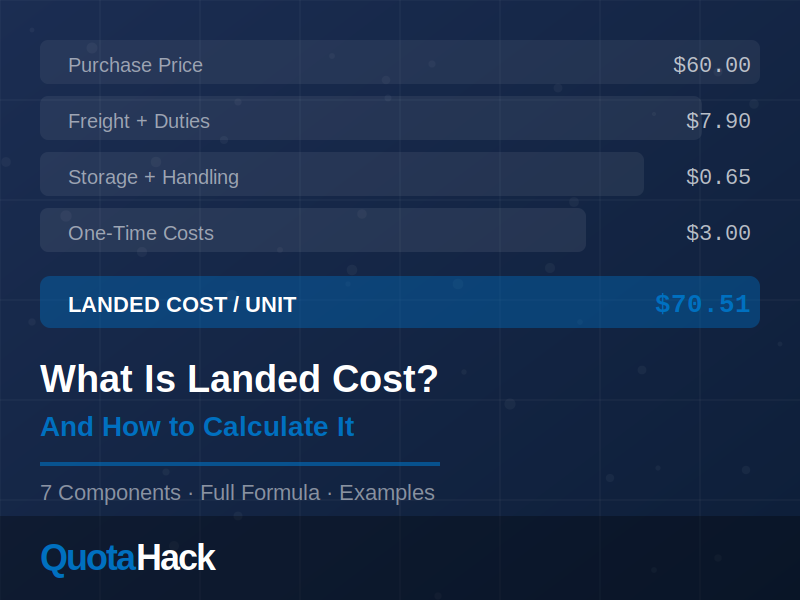
- Landed cost calculated the same way every time — duties, freight, insurance, and fees rolled into one number automatically, instead of rebuilt by hand in a new tab for every deal.
- A record of what assumptions went into each quote, so when a rate changes, it's clear which open quotes are now underpriced.
That's the difference between a pricing process and a pricing habit. Quotahack's landed cost and B2B pricing tools are built to close that exact gap — replacing the static tab with numbers that stay current as tariffs, freight, and FX move.
FAQ
Why do international trade quotes go stale so quickly in 2026?
Because the three biggest cost inputs — tariffs, freight rates, and currency — are all moving faster than in previous years. A quote built on this week's numbers can be materially wrong within days if any one of those shifts.
How much can a currency swing actually affect a trade deal's margin?
On a deal quoted with a typical 10–12% margin, even a 3–5% adverse currency move between quote and payment can wipe out a quarter or more of that margin — before accounting for freight or duty changes on the same shipment.
Is switching away from spreadsheets really necessary, or is this a training problem?
It's a structural problem, not a skills problem. Even well-built spreadsheets are static by design — 94% of business spreadsheets contain errors, and the ones that don't still can't automatically reflect a tariff change that happened after the formula was written.
What should a business use instead of a manual spreadsheet for landed cost and trade pricing?
A tool that pulls current duty, freight, and FX inputs into the calculation automatically, rather than one that relies on someone remembering to update a cell every time a rate changes. Quotahack's calculators are built for exactly this.


Start where it feels easiest
Whether you want a guide, a tool, or direct help, there’s a simple way to begin.
Reassurance: Built for everyday operators who want practical AI help now.